
Journal·July 31, 2026·stargazing · things-to-do · sedona-nights · local-tips · no-crowds
Sedona Stargazing: Where to Go and When (No Telescope Required)
Sedona sits at 4,500 feet with almost no light pollution to the north — here's where I actually go to watch the sky

Photo by Anthony Melone on Unsplash
Most people come to Sedona for the red rocks. A fair number leave talking about the night sky. That's not an accident — at 4,500 feet, with the Coconino National Forest swallowing most of the surrounding land, the darkness out here is real. You don't need gear. You don't need a plan beyond a blanket and some patience.
Here's what I've figured out after a few years of living with this sky overhead.
Why Sedona Works for Stargazing
The elevation helps. So does the desert air, which holds less moisture than coastal or lowland climates. On a clear night, the Milky Way core is visible to the naked eye from late spring through early fall — not as a vague smudge, but as an actual band with structure you can pick out.
Sedona itself has some ambient glow from Uptown and Highway 89A, but it dissipates fast once you're half a mile out of town. The bigger threat to dark skies is actually Flagstaff and the Verde Valley — but the red rock formations block a lot of that horizon pollution, which is part of what makes the views so good.
The Best Spots I've Found
Airport Mesa is the easiest and most accessible. There's a pullout near the top of Airport Road where people park legally after sunset. The 360-degree view is hard to beat. Downside: it's not a secret, and on weekends you may have company. Still worth it.
Red Rock State Park closes at dusk — so technically it's off the list unless you're there for one of their ranger-led stargazing nights, which happen occasionally and are genuinely good.
Schnebly Hill Road is where I send guests who want solitude. It's a maintained dirt road (passenger cars are usually fine in dry conditions — don't attempt after rain), and within a mile or two you're genuinely dark. The rock formations around you give the sky a framing you won't get in an open field. Pull over anywhere that feels safe and wide.
The Chapel of the Holy Cross area — specifically the pullouts along Chapel Road and the surrounding BLM land — faces east, which is where the Milky Way core rises in summer. Some of my favorite photos have come from right around there.
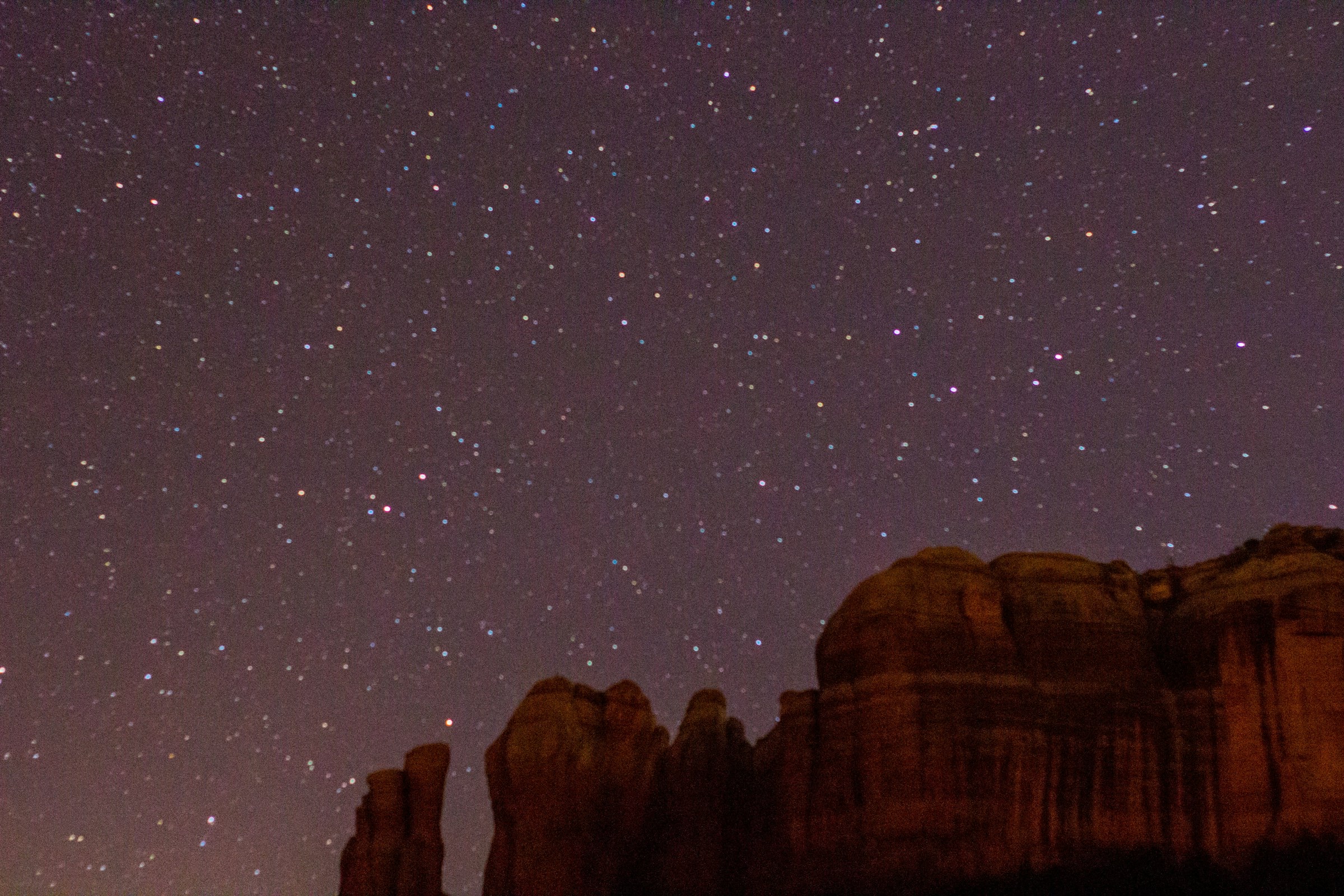
The eastern sky above Cathedral Rock — this is roughly what you'll see from the Chapel Road pullouts on a clear summer night, no camera filter needed.
When to Go
The Milky Way core is visible from roughly March through October, with peak visibility in June and July when it's highest in the sky. New moon weekends are the target — the difference between a full moon night and a new moon night is dramatic. I check the moon phase before I recommend any specific night to guests.
Monsoon season (July–September) brings afternoon storms that usually clear by 9 or 10 p.m. Those post-storm nights, when the air has been washed clean, are some of the best I've seen. Just be aware the roads can be muddy.
Winter is underrated. No crowds, colder temps (bring more than you think you need — it drops fast after sunset), and the Orion nebula is high in the sky by 8 p.m. The stars feel sharper somehow.
What to Bring, Practically Speaking
A blanket or two, more layers than you think you need, red-light flashlight if you have one (it preserves night vision in a way white light doesn't), and water. That's it.
Give your eyes 20 minutes to adjust before you decide the sky is disappointing. The first five minutes out of a lit car, everything looks dim. By minute 25, you'll start seeing things you didn't know were there.
Phone apps like SkySafari or even Google's Sky Map are useful if you want to know what you're looking at, but I usually just lie on my back and let the scale of it hit me without narration.

Bell Rock on a clear night — the warm glow on the horizon is Village of Oak Creek, which is faint enough that it doesn't wash out what's overhead.
A Few Honest Caveats
Sedona is not a designated dark sky park. Flagstaff, 30 miles north, actually holds that certification. If you're serious about astrophotography, Flagstaff's Anderson Mesa is the technical answer. But for a person on a trip who wants to see the Milky Way with their own eyes and feel genuinely small for a few minutes — Sedona delivers, and you don't have to drive anywhere extra to get it.
Also: wildlife is active at night. I've had javelinas walk through a stargazing spot at Schnebly Hill. Not dangerous, just startling. Don't leave food in an unlocked car.
If you make it out to Schnebly Hill Road on a new moon night this summer, go at least a mile in before you stop — and then just wait. The sky will do the rest.
Notes from Sedona
Want these in your inbox?
Once a month I send the new posts straight to subscribers. Skip checking the site.